
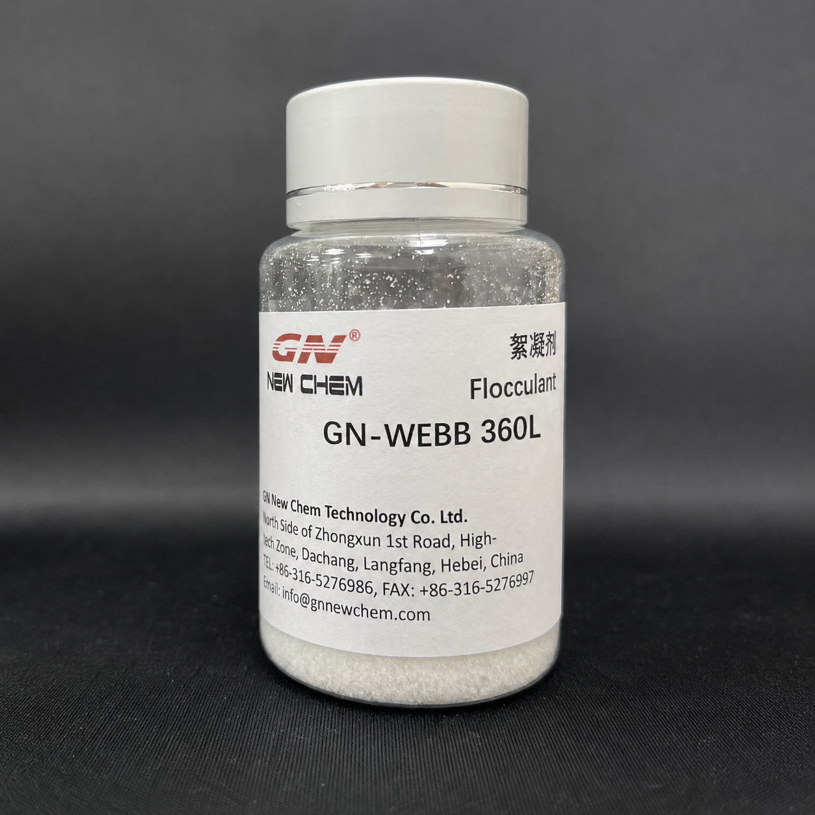
Rapidly neutralizes negatively charged organic colloids, heavy emulsified oil, and fine suspended solids, forming compact, dense flocs over a broad operating pH range.
The product is particularly suited to heavy-oil produced-water polishing and demulsification, high-oil sludge conditioning and dewatering, high-organic biological sludge dewatering, high-COD chemical wastewater clarification, high-solids drilling-waste treatment, and injection-water polishing.
GN-WEBB 300 dissolves uniformly and supports continuous automated dosing at oilfield sludge-treatment facilities, produced-water plants, and large municipal or industrial wastewater treatment systems.
Advantages
- High cationic charge density rapidly neutralizes negatively charged colloids and provides strong adsorption and capture performance, accelerating floc formation and reducing retention time in settling tanks and centrifuge feed systems.
- Efficiently captures high concentrations of suspended solids, heavy emulsified oil, and high-molecular-weight organic colloids, significantly reducing effluent turbidity and residual oil content.
- Forms compact, robust flocs with excellent press dewatering performance, producing clear filtrate, lower cake moisture, and substantial sludge-volume reduction.
- Delivers strong synergistic performance with oilfield demulsifiers and inorganic coagulants without causing secondary emulsification or fine floating flocs.
- Provides stable separation of high-solids drilling waste fluids, efficiently removing dense solids and reducing wear on centrifuges, pipelines, and associated solids-control equipment.
Applications
- Clarification and solid-liquid separation of high-solids drilling mud and drilling waste fluids.
- Advanced turbidity removal, demulsification, and oil removal from heavy-oil produced water and injection water.
- Flocculation and clarification of high-organic municipal wastewater and high-COD chemical wastewater.
- Deep dewatering and volume reduction of high-organic biological sludge and physicochemical sludge.
- Conditioning, thickening, and dewatering of high-oil contaminated soil, oily sludge, and tank-bottom sludge.
- Solid-liquid separation of high-turbidity mine water and surface water containing elevated organic matter
Typical Properties
- Appearance: White, free-flowing granular powder
- Solid Content: ≥90.0%
- Molecular Weight: Customized to application requirements
- Test Methods: Visual / gravimetric oven-drying / Ubbelohde viscometer
Recommended Treatment
- Wastewater flocculation and clarification: 1.5-7 mg/L
- Drilling-fluid solid-liquid separation: 1.2-5 mg/L
- Conventional biological/physicochemical sludge dewatering: 4-12 kg/t dry solids
- High-oil sludge auxiliary flocculation: 100-1,000 mg/L
- Final dosage should be established through laboratory jar testing and dynamic field optimization under actual oilfield or wastewater-treatment conditions.
- Recommended solution concentration: Prepare a 0.1%–0.5% aqueous solution. Do not feed the dry powder directly, as it may form fisheyes or agglomerates, resulting in incomplete dissolution and chemical waste. The make-up water temperature should not exceed 50°C to prevent polymer degradation and loss of performance.
- Recommended injection points: Wastewater flocculation reaction tank, sludge-conditioning tank, drilling-fluid centrifuge feed inlet, oilfield produced-water settling tank, and excavated oily-sludge conditioning system.
Package
- Standard package: 25 kg woven sack with PE liner. Emulsion grades may be supplied in 200 kg plastic drums or 1,000 kg IBCs. Customized packaging and labeling are available upon written confirmation.
- Shelf life is 12 months in the original sealed packaging. Store tightly sealed in a cool, dry, well-ventilated warehouse.
- Protect from direct sunlight, heat, rain, and moisture. Keep bags on pallets, as the product is hygroscopic and may cake when exposed to humidity.
Compatibility
- Compatible with conventional oilfield and water-treatment chemical programs. For enhanced flocculation, sludge dewatering, and oil-water separation, dose inorganic coagulants such as polyaluminum chloride, polymeric ferric
- sulfate, ferric chloride, or aluminum sulfate before GN-WEBB 300. The product is also compatible with oilfield demulsifiers when applied at separate injection points.
- Do not dissolve with concentrated caustic soda, quicklime, or other strong alkalis, as prolonged high-pH exposure may degrade the polymer chain. Do not dissolve or inject at the same point as anionic polyacrylamide; direct contact may cause immediate bulk precipitation and loss of product performance. Dose separately from corrosion inhibitors, biocides, and scale inhibitors to maintain overall system stability.