

Shale Inhibitors and Clay Stabilizers for Water-Based Drilling Fluids
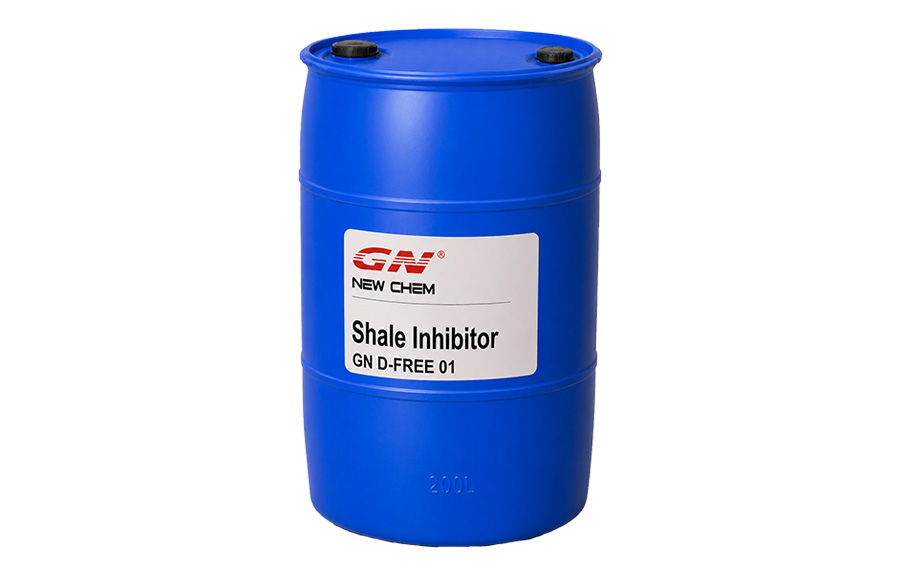
GN D-FREE Series
Shale inhibitors and clay stabilizers reduce clay hydration, swelling, dispersion, and cuttings degradation. They improve wellbore stability, maintain cleaner drilling fluids, and reduce dilution and waste volumes in reactive formations.
GN New Chem supplies shale inhibitors and clay stabilizers for customers who need dependable chemical performance under real operating conditions. Product selection is based on clay mineralogy, salinity, temperature, environmental limits and compatibility with polymers. Standard and customized grades can be evaluated according to the customer’s process, target result and supply requirements.
Product Overview
Shale Inhibitors and Clay Stabilizers are specialty chemical products formulated to reduce clay hydration, swelling, dispersion and accretion to improve wellbore stability. They are intended to improve process stability and help the treatment or operating system achieve a more consistent result. Because feed properties and operating conditions can vary substantially, the recommended grade and dosage should be confirmed through laboratory screening and, when practical, a controlled field trial.
Main Functions
- Reduce clay hydration, swelling, dispersion and accretion to improve wellbore stability.
- Support stable operation of downstream separation, treatment or production equipment.
- Reduce performance variation caused by changing feed composition or operating conditions.
- Help optimize total treatment cost by balancing product performance, dosage and process efficiency.
Features and Advantages
- Application-specific selection: grades are matched to the customer’s fluid chemistry, solids profile, temperature and process objective.
- Process compatibility: products can be screened with existing chemicals and equipment before full-scale use.
- Flexible formulation approach: options may be available for different concentration, active chemistry, handling and environmental requirements.
- Technical evaluation support: sample testing, comparative screening and dosage optimization can be arranged according to project needs.
- Reliable supply planning: packaging, labeling and export documents can be prepared for the destination market, subject to product and regulatory availability.
Typical Applications
Typical applications include reactive shale drilling, water-sensitive formations, completion fluids and workover fluids. The product may also be considered for related operations where the same separation, control or treatment mechanism is required. Final suitability depends on the actual system and should not be determined solely from the application name.
Recommended Use
- Review the feed or operating-fluid analysis, treatment objective and process limitations.
- Select candidate grades through a representative laboratory test or compatibility screening.
- Prepare and dose the product according to the product form, mixing requirement and safe-handling instructions.
- Introduce the chemical at a point that provides adequate dispersion, reaction or contact time without excessive shear.
- Start with the laboratory-derived dosage range, monitor key operating indicators and adjust gradually.
- Confirm sustained performance through a controlled field trial before establishing the routine treatment program.
Always follow the approved TDS, SDS, site chemical-management procedure and applicable local regulations. The optimum dosage is system-specific and should be based on performance data rather than a generic fixed rate.
Packaging, Storage and Transportation
- Packaging: 25 kg/sack or 1 MT/sack for powder/granular and 25L pail or 200L drum for liquid.
- Store in the original sealed package in a dry, ventilated area, protected from incompatible materials, contamination, direct sunlight and extreme temperatures. Prevent freezing where applicable.
- Transportation classification, labeling and documentation will be confirmed according to the final formulation, destination country and shipment method.
Information Needed for Product Selection
- Application and process objective, including the current operating problem related to shale inhibitors and clay stabilizers.
- Representative sample and analysis; key selection factors include clay mineralogy, salinity, temperature, environmental limits and compatibility with polymers.
- Current chemical program, supplier grade, dosage and observed performance.
- Process flow, chemical injection point, mixing/contact time and separation equipment.
- Operating temperature, pressure where relevant, pH, salinity and other compatibility constraints.
- Target product, water, solids, drilling-fluid or process specification and how performance will be measured.
- Daily or monthly consumption, preferred packaging, delivery location and required documentation.
Why GN New Chem
GN New Chem combines specialty-chemical supply with practical knowledge of separation equipment and treatment processes. This enables our team to evaluate not only the chemical itself, but also how dosing, mixing, retention time, solids handling and downstream equipment influence the final result. Our objective is to provide a technically defensible product recommendation and a practical route from sample testing to field application.
Request a Product Recommendation
Send GN New Chem your application data and sample information for a preliminary review of suitable shale inhibitors and clay stabilizers. We can propose candidate product types, testing steps, required sample volume and commercial supply options for your project.