
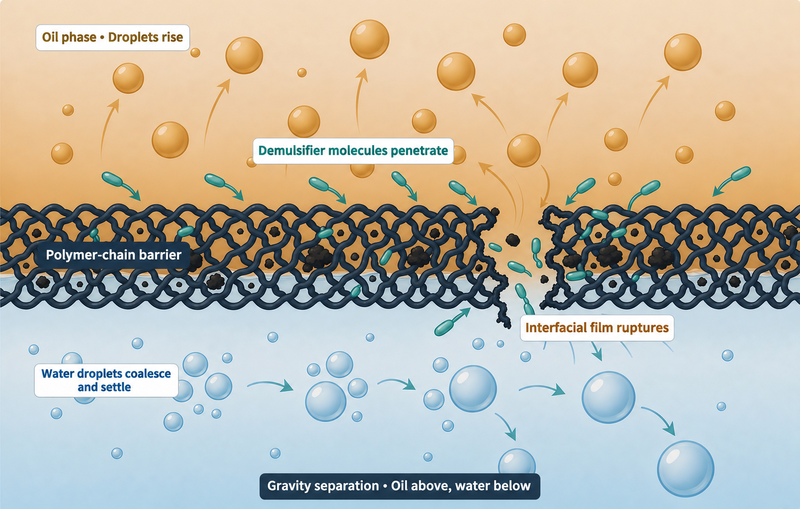
Water in the produced fluid is dispersed as small droplets surrounded by an interfacial film. Residual polymer strengthens this film and makes it harder for droplets to coalesce and settle. The resulting persistent emulsion can lead to high water content in the oil, a thick rag layer and higher treatment costs.
How demulsifiers work
The demulsifier penetrates the barrier formed by polymer chains, reaches the oil–water interface and disrupts the interfacial film. This allows water droplets to coalesce and settle, promoting oil–water separation.
Demulsifier action at the oil–water interface
Four Steps for Demulsifier Selection
Each emulsion system has an optimum dosage range. Bottle tests help identify that range before a field trial.
Bottle-test reference cited in the source: SY/T 5280-2018, General Technical Requirements for Crude Oil Demulsifiers.
1 Sample collection
- Collect 500 mL to 1 L of representative crude oil. Avoid blended oil samples. Sample during both normal and peak operation, and record the temperature and salinity.
- Fill the glass bottle completely to eliminate headspace. Refrigerate at 4 °C and deliver within 48 hours. Provide the field temperature, injection point and current dosage.
2 Laboratory bottle test
- Transfer 100 mL of emulsion into a stoppered graduated cylinder and record its initial condition.
- Use a microsyringe to test dosages of 50, 100, 150, 200 and 300 ppm. Mix by inverting the cylinder 10 times. Avoid magnetic stirring.
- Let the samples settle at the field test temperature, typically 60–65 °C for polymer-flood fluids. Record the separated water volume at 5, 15, 30, 60 and 120 minutes.
|
Parameter |
Acceptance criterion |
Warning sign |
|
Dehydration efficiency |
≥90% |
<80%, adjust dosage or formulation |
|
Oil–water interface |
Sharp and free of flocs |
Diffuse or opalescent |
|
Rag layer volume fraction |
≤1.0 vol% |
>3%, incomplete separation |
|
Separated-water clarity |
Clear, with low oil content |
Cloudy, with suspended flocs |
|
Separation time |
Distinct layers within 30 min |
Apparent separation within 1 min may be misleading |
3 Field trial
Run a continuous trial for 24–72 hours. Monitor the water content of the treated oil and the oil content of the separated water. Check the emulsion layer in the electrostatic dehydrator or settling tank. Vary the dosage to assess tolerance to dosing changes.
4 Ongoing optimization
Crude properties can change as a field matures. Repeat laboratory screening every 3–6 months and regularly check the water layer color and interface. Dark water or visible flocs can be early warning signs.
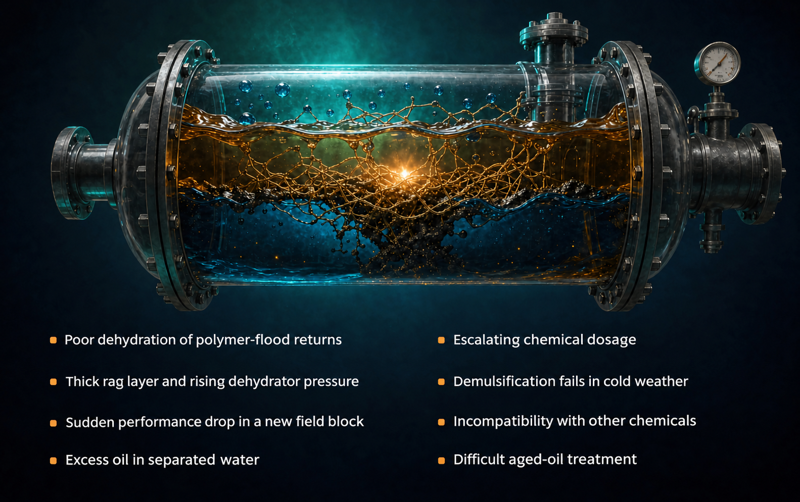
Common Field Demulsification Problems
Eight operating challenges in field demulsification
Laboratory testing and product selection
If you are experiencing demulsification problems, send GN New Chem your crude oil type, water cut, operating temperature and current chemical dosage. Our technical team can conduct laboratory bottle tests and recommend a demulsifier for your operating conditions.