
Tunnelling slurry cannot be discharged untreated. It must undergo solid-liquid separation and purification, with recovery and reuse wherever practicable. This is essential for maintaining slurry performance and safe, continuous excavation, while reducing material consumption and off-site disposal costs and ensuring environmental compliance.

Treatment Process: Staged Recovery Followed by Advanced Treatment
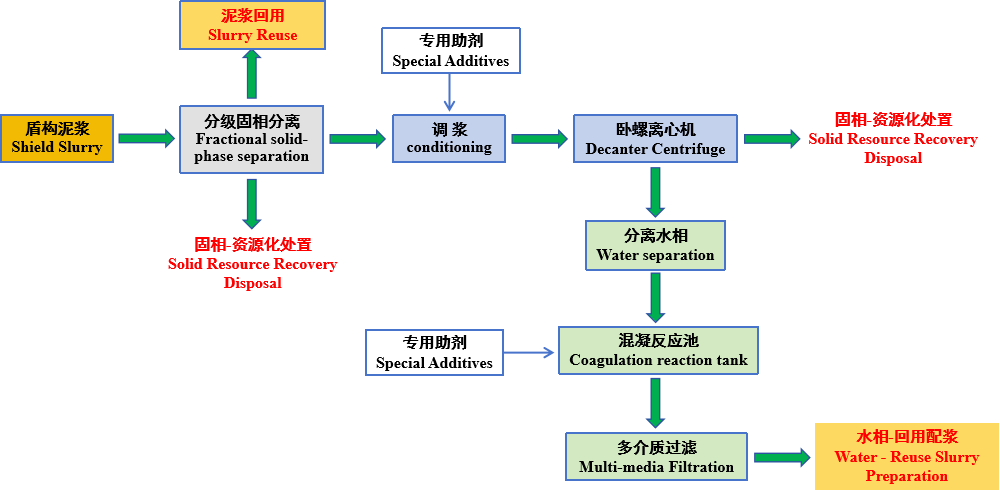
Treatment comprises two main stages: solid-liquid separation and water treatment. Screening and hydrocyclone separation first remove oversize solids and fine sand. Recovered slurry that meets the required criteria is conditioned and returned to the circulation system. Non-reusable slurry is treated by centrifugation with a suitable flocculant. The separated solids are transported off-site or sent for resource recovery, while the water is further treated by flocculation, filtration and water-treatment chemicals before reuse in slurry preparation.
 Chemical
Enhancement: Destabilization, Aggregation and Separation of Fine Particles
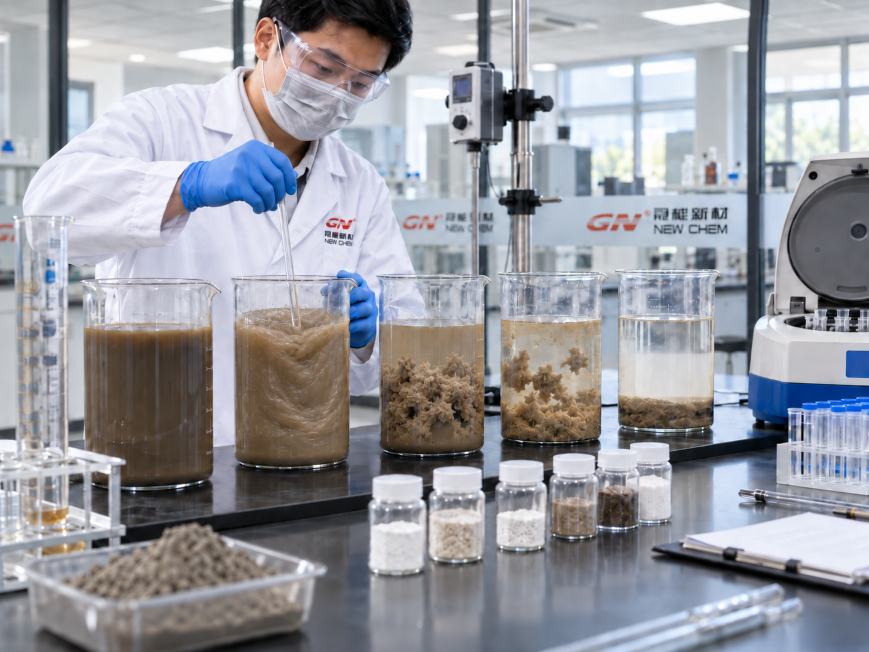
Select coagulants, flocculants and conditioning aids based on mineralogy, solids content, pH, particle size and salinity. Compatibility and process trials establish the optimum chemical program.
Chemical and Equipment Integration Determines Treatment Performance
Slurry properties vary by geology: sandy formations require rapid desanding and high throughput, while clay-rich formations require fine-particle destabilization, flocculation and dewatering. GN New Chem integrates chemicals and equipment from slurry characterization and process design through bench-scale validation and field support, improving recovery and treatment efficiency.
Recommended Technical Workflow:
- Characterize density, viscosity, solids, pH and particle size;
- Compare coagulation, flocculation, settling and dewatering;
- Define product, blend ratio, dosing point and optimum dosage;
- Match screens, hydrocyclones, centrifuges or filter presses;
- Validate field operation and optimize parameters as conditions change.