
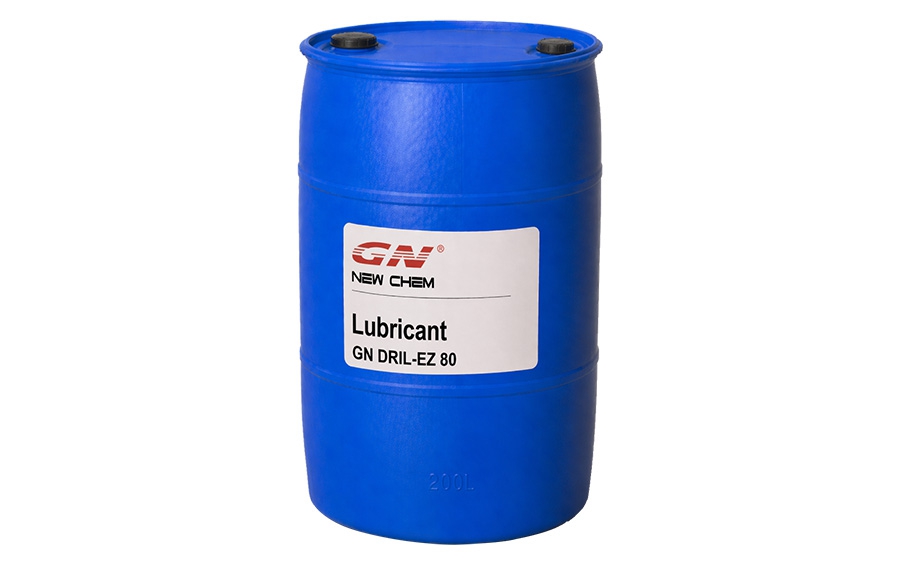
Overview
This series of Lubricants is designed to reduce friction between drilling fluids, the wellbore, and drillstring components. By forming a lubricating film at contact interfaces, these products significantly lower torque and drag, enhance drilling efficiency, and minimize mechanical wear. They are suitable for both water-based and oil-based drilling fluids and perform reliably in complex well profiles and challenging conditions.
Technical Specifications
| Product Code | Function/Application | OBM/WBM | Temperature (°C) | Features | Availibility |
|---|---|---|---|---|---|
| GN DRIL-EZ 50 | Standard-usual lubricant,WBM, produced water or brine | WBM | 200 | Cost-effective, high-performance | Liquid / 55gal |
| GN DRIL-EZ 60 | All types of water-based drilling fluids | WBM | 200 | Hydrocarbon-free, ideal for offshore applications | Liquid / 55gal |
| GN DRIL-EZ 80 | EP lub in horizon wells | WBM | 200 | Hydrocarbon-free, ideal for offshore applications | Liquid / 55gal |
| GN DRIL-EZ 90 | All types of water-based drilling fluids | WBM | 220 | HT application | Liquid / 55gal |
Key Functions
- Reduce friction coefficient, torque, and drag
- Improve lubrication between drillstring and wellbore
- Enhance sliding performance in directional and horizontal drilling
- Minimize risks of stuck pipe and mechanical wear
- Improve overall drilling efficiency and operational safety
Features
- Excellent lubrication performance under high-load conditions
- Strong thermal, salt, and contamination resistance
- Good compatibility with conventional drilling fluid systems
- Minimal impact on rheology and other fluid properties
- Available in various types (e.g., oil-based, ester-based, polymer-based, blended systems)
- Environmentally friendly and biodegradable options available
Applications
- Horizontal, directional, and extended-reach wells
- High torque and drag environments
- High-density or high-solids drilling fluids
- Conditions prone to stuck pipe or excessive friction
- Improving rate of penetration (ROP) and reducing equipment wear